
Lead Source Field: Train Your CRM to Show You the Money
Article Summary: Every marketing dollar you spend is a bet—and right now, most small business owners are placing those bets without knowing which ones have ever paid off. The Lead Source field in your CRM is the single most underleveraged data point in small business revenue intelligence. It is free to implement, takes minutes to set up, and answers the most valuable question in your business: which specific marketing activities are actually generating revenue? This article shows you exactly how to activate it, track it, and use it to make every future marketing investment smarter.
Key Takeaway: The ROI Detective doesn’t manage marketing by intuition. They track every lead back to its source—consistently, precisely, and systematically—so that every marketing budget decision is driven by evidence of what has actually generated revenue, not by what feels like it’s working. The Lead Source field is not a CRM feature. It is the foundation of your entire marketing ROI measurement system.
Why It Matters: Qwilr research found that companies with mature revenue attribution practices achieve 36% more revenue growth than those without. And a Salesforce study shows that 68% of marketers still struggle to directly attribute revenue to specific marketing activities. The Lead Source field solves this problem at the most fundamental level—before any analytics tool, any dashboard, or any reporting system can produce meaningful intelligence, you need clean, consistent lead source data in your CRM. Everything else is built on top of this foundation.
🏆New Dawn CRM | All-in-One Small Business CRM
In This Article:
The Revenue Attribution Problem Every Small Business Owner Is Living With
What a Lead Source Field Actually Is (And Why It’s Worth More Than You Think)
The Referral Problem: Why “I Think It Was Word of Mouth” Isn’t Good Enough
How to Set Up Your Lead Source Taxonomy in Any CRM
The “How Did You Hear About Us?” Field: Your Inquiry Form’s Most Valuable Question
Training Your Team to Ask and Record It Every Single Time
From Lead Source Data to Revenue Intelligence: The Monthly ROI Review
The Six Marketing Decisions Lead Source Data Makes Automatic
CRM Tools That Make Lead Source Tracking Effortless
What the ROI Detective Does That Their Competition Doesn’t
The Identity Shift: Becoming the ROI Detective
The Cost of Inaction: The Marketing Spend You Can Never Justify
Your Next Move: Take Practical Action Now
BONUS: The Revenue Attribution Intelligence System™ from New Dawn Solutions
The Revenue Attribution Problem Every Small Business Owner Is Living With
Here is a question every business owner should be able to answer in under 30 seconds:
Which specific marketing activity generated the most revenue for your business in the last 90 days?
If the answer comes with hesitation, a shrug, or a response that begins with “I think—” then you are operating in one of the most expensive forms of strategic ignorance in business: revenue attribution blindness.
You know your revenue. You know your expenses. You might even know your conversion rate.
But do you know which LinkedIn post, which email campaign, which referral partner, or which Google search term is responsible for the clients who actually paid you?
Most small business owners don’t. And the cost of that ignorance is compounding every month they continue operating without a system to capture it.
The system is not complicated. It is not expensive. And it begins with a single field in your CRM.
The Lead Source field.
This is the article that shows you how to use it—and why doing so will permanently change how you make marketing investment decisions.
What a Lead Source Field Actually Is (And Why It’s Worth More Than You Think)
A Lead Source field is a data field in your CRM (Customer Relationship Management system) that records how each prospective client first found your business.
It is, in its simplest form, a structured answer to the question: “How did this person hear about us?”
In a well-configured CRM, this field appears as a dropdown menu with standardized values—Referral, Organic Search, LinkedIn, Email Marketing, Paid Ads, Event/Networking, and so on—so that every lead is tagged with a consistent, comparable source designation.
Over time, this field becomes one of the most valuable datasets in your business:
It shows you which sources generate the most leads.
It shows you which sources generate the highest-converting leads.
It shows you which sources generate the highest-value clients.
And it shows you which sources generate the most revenue per dollar of time and budget invested.
This is not marketing analytics. This is revenue intelligence. And most small businesses are leaving it entirely uncaptured.
“We make investment decisions daily based on assumptions about what’s working. The Lead Source field replaces those assumptions with evidence.”
The Referral Problem: Why “I Think It Was Word of Mouth” Isn’t Good Enough
Ask most small business owners where their best clients come from, and you’ll hear some version of:
“Mostly referrals, I think.”
Probably true. But “I think” is a strategy failure disguised as a success story.
If referrals are your strongest lead source—and for most service businesses, they are—then the data to prove it is worth its weight in gold. Because when you know with precision that 64% of your highest-value clients came from referrals, and that those clients have an average deal value 40% higher than your ad-generated leads, you now have the evidence to:
Invest in a structured referral incentive program.
Prioritize client relationships as a primary growth lever.
Reduce or eliminate paid advertising that costs more per client than referrals.
Design a specific ask-for-referral protocol at the right moment in every client relationship.
That level of strategic precision is not possible with “I think it’s mostly referrals.” It only becomes possible when every lead, every client, and every closed deal has a source tag attached to it in your CRM.
According to the Wharton School’s research on customer acquisition, referred customers have a 16% higher lifetime value than non-referred customers, are 18% less likely to churn, and generate 25% more referrals themselves. If referrals are your strongest channel, measuring them precisely is not a nice-to-have. It is a strategic imperative.
How to Set Up Your Lead Source Taxonomy in Any CRM
A taxonomy is simply a structured list of categories. Your Lead Source taxonomy is the standardized list of source values that every lead in your CRM will be tagged with.
The key principle: fewer, broader categories produce better data than many, narrow ones. If you create 30 specific sources, your data will be fragmented. If you create 10 standard categories that cover every scenario, your data will be clean, comparable, and actionable.
Here is the recommended Lead Source Taxonomy for small businesses, along with standard CRM values and columns to track over time:
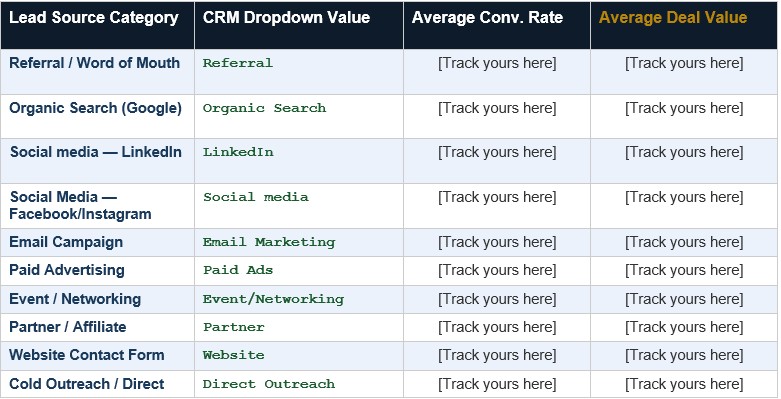
How to Set Up Your Lead Source Taxonomy in Any CRM
Set these up as a dropdown field in your CRM—today. Every new lead that enters your system from this day forward gets tagged immediately. Retroactively tag historical leads where possible. Within 90 days, you will have the most valuable data report in your business.
🏆New Dawn CRM | All-in-One Small Business CRM
The “How Did You Hear About Us?” Field: Your Inquiry Form’s Most Valuable Question
Your website contact form is the most common point of first contact between potential clients and your business. And for most small businesses, that form collects three pieces of information: name, email, and message.
All three miss the most commercially valuable question you could ask:
“How did you hear about us?”
Adding this as a dropdown field—not a text box—to your inquiry form is one of the single highest-ROI form optimizations a small business can make. It requires no coding expertise. It takes five minutes to add. And it begins populating your Lead Source data automatically, from the first inquiry forward.
The dropdown options should mirror your CRM taxonomy exactly:
Google / Organic Search
Referral from a friend or colleague
LinkedIn
Facebook / Instagram
Email Newsletter
Google Ad
Event / Networking
Other (please specify)
The “Other (please specify)” option is critical. It captures the sources you haven’t anticipated—and often reveals valuable channels you didn’t know were working.
According to a study by Unbounce, adding a single, well-placed qualifying field to a contact form does not significantly reduce form completion rates—meaning you get the data without sacrificing leads.
Training Your Team to Ask and Record It Every Single Time
Online forms capture self-reported lead sources. But for many small businesses, a significant portion of leads arrive through phone calls, in-person meetings, events, or direct messages—and no form captures those.
This is where team training becomes mission-critical.
Every team member who has first contact with a potential client needs a simple, natural script for asking the source question—and a non-negotiable process for recording the answer in the CRM before the conversation ends.
THE LEAD SOURCE INTAKE SCRIPT:
"Before we dive in, do you mind if I ask: how did you hear about us?"
Then record the answer in the CRM immediately. No exceptions. No “I’ll do it later.” The data only exists if it’s captured in the moment.
The single biggest enemy of lead source data quality is inconsistency. If your team records “LinkedIn” for some leads and forgets to record anything for others, your data is useless. The value of lead source tracking compounds directly with the consistency of data entry.
Salesforce’s research on CRM adoption found that teams with standardized data entry protocols produce data that is 40% more accurate and 60% more actionable than teams without them.
From Lead Source Data to Revenue Intelligence: The Monthly ROI Review
Once your Lead Source field is populated with 90 days of data, the monthly ROI review becomes the most valuable 30 minutes in your business calendar.
Here is the exact process—run it in your CRM or export to a simple spreadsheet:
Step 1: Generate Your Lead Source Report: Filter your CRM by the past month (or quarter). Count the number of leads by source. This is your acquisition volume by channel.
Step 2: Add Conversion Data: For each source, count how many leads converted to clients. Calculate your conversion rate by source: (closed / total leads) x 100.
Step 3: Add Revenue Data: For each source, total the revenue from closed deals. Calculate average deal value by source: total revenue / number of closed deals.
Step 4: Calculate Revenue per Lead by Source: Divide total revenue from each source by the number of leads from that source. This is your most important metric: revenue generated per lead, per channel.
Step 5: Make Three Decisions: Based on the data, identify: (1) the highest-ROI source to invest more in, (2) the lowest-ROI source to test differently or reduce, (3) one new channel hypothesis to test next month.
Here is the Monthly ROI Detective Review table for your reference—printable and ready to populate:
Lead Source: Referral
# Leads: ___
# Closed: ___
Revenue: $______
Decision / Action: _______________
Lead Source: Organic Search
# Leads: ___
# Closed: ___
Revenue: $______
Decision / Action: _______________
Lead Source: LinkedIn
# Leads: ___
# Closed: ___
Revenue: $______
Decision / Action: _______________
Lead Source: Email Marketing
# Leads: ___
# Closed: ___
Revenue: $______
Decision / Action: _______________
Lead Source: Paid Ads
# Leads: ___
# Closed: ___
Revenue: $______
Decision / Action: _______________
Lead Source: Event/Networking
# Leads: ___
# Closed: ___
Revenue: $______
Decision / Action: _______________
The Six Marketing Decisions Lead Source Data Makes Automatic
With consistent lead source data, six of the most important marketing decisions in your business become straightforward rather than speculative:
1. Where to increase your marketing budget: The source with the highest revenue per lead gets more investment. Full stop.
2. Where to cut or reduce your marketing spend: The source with the lowest revenue per lead, or zero closed deals, gets reduced or eliminated.
3. Whether your referral program is working: If referral volume is declining or flat, you have data to justify investing in a structured referral program.
4. Which campaigns to run again: If last quarter’s email campaign generated your highest conversion rate, you repeat and iterate it.
5. Which partnerships are worth maintaining: If a specific partner is generating 15% of your revenue with zero ad spend, you invest in that relationship.
6. What your next quarter’s marketing strategy should prioritize: Instead of guessing, you build next quarter’s plan around the channels that generated the most revenue this quarter.
CRM Tools That Make Lead Source Tracking Effortless
You don’t need a complex, expensive enterprise CRM to implement lead source tracking. Here are the best options for small businesses at every level:
New Dawn CRM: Specifically designed for small businesses, it offers a truly all-in-one platform that automatically streamlines every Lead Source field discussed in this article. With a single click, you can add custom Lead Source options tailored to your business, ensuring maximum flexibility. The platform provides intuitive pipeline visualization, automated data capture, workflow automation, robust management tools, and comprehensive lead source reporting, all powered by integrated analytics and seamless multi-platform support. With advanced AI integration, New Dawn CRM is perfectly suited for small teams or solo operators who want to save time and make smarter decisions.
💡See how it works: https://newdawncrm.com/
HubSpot CRM (Free) The best free CRM for small businesses. Includes a native Lead Source field, pipeline management, and reporting. The free tier is genuinely powerful.
Notion + Simple Database For businesses not ready for a full CRM, a Notion database with a Lead Source property is a practical starting point.
Pipedrive ($14.90/mo) Sales-focused CRM with excellent pipeline visualization and lead source reporting. Ideal for service businesses.
Zoho CRM (Free for 3 users) Feature-rich CRM with built-in lead source tracking, email integration, and reporting at a competitive price.
What the ROI Detective Does That Their Competition Doesn’t
The highest-performing small business owners and marketers share a discipline that their competitors rarely match:
They treat their marketing budget like a portfolio—and they review the returns on every position, every month, using actual data.
McKinsey’s research on data-driven marketing found that organizations that use data to make marketing investment decisions outperform their peers by up to 20% in sales growth—not because they have bigger budgets, but because they allocate those budgets more precisely.
The ROI Detective isn’t more analytical than their competition. They’ve simply installed one additional habit: asking “How did you hear about us?” at the beginning of every client relationship, and recording the answer every single time.
That habit, compounded over 12 months, produces a revenue attribution map that transforms how they spend every future marketing dollar.
The Identity Shift: Becoming the ROI Detective
There are two types of business owners operating in the marketing investment landscape.
The first is the Gut-Decision Manager. They spend money on marketing because they feel like they should be visible. They run ads because competitors run ads. They post on social media because everyone says you have to. They make their marketing decisions based on what seems right, what feels productive, and what their peers appear to be doing.
The second is the ROI Detective.
The ROI Detective follows the money trail back to its source. They know, with data, which channels produce clients. They know which clients stay longest, spend most, and refer the most. They know this because they’ve installed a simple system—a Lead Source field, a consistent intake question, and a monthly 30-minute review—that transforms every marketing activity from an opinion into an evidence-based investment decision.
The ROI Detective doesn’t spend more on marketing than the Gut-Decision Manager. They spend less—because they spend better. They concentrate resources on what works. They cut what doesn’t. And their revenue per marketing dollar invested compounds every quarter because their data gets richer and their decisions get more precise.
You become the ROI Detective not by becoming a data scientist, but by instilling the discipline to consistently ask, record, and review one question: “How did this client find us?” That question, answered over 12 months, is worth more than any marketing tool you will ever buy.
The Cost of Inaction: The Marketing Spend You Can Never Justify
Every month you operate without a Lead Source tracking system, you are paying for one of the most expensive forms of operational blindness in business.
You are spending money on marketing channels you cannot evaluate. You are making next quarter’s budget decisions based on intuition rather than evidence. And you are leaving your most valuable marketing insight—which channel generates your best clients—completely uncaptured.
The compounding cost:
You continue funding channels that generate high lead volume but low close rates and low client value—because the data to reveal this hasn’t been captured.
You underinvest in channels like referral or organic search that generate your highest-value clients—because you can’t prove the connection without source data.
You cannot make a credible business case to yourself (or a partner, investor, or board) about which marketing investments are generating returns.
You repeat the same marketing mistakes—because without source data, there’s no mechanism to learn from them.
According to Qwilr’s research, companies with mature revenue attribution practices achieve 36% higher revenue growth than those without. At $20,000 in monthly revenue, that gap represents $7,200 per month—or $86,400 per year—in unrealized revenue attributable directly to attribution discipline.
The cost of not tracking lead sources is not abstract. It is measurable, compounding, and entirely avoidable.
It stops the moment you add one field to your CRM and ask one question of every new prospect.
Your Next Move: Take Practical Action Now
The revenue intelligence system described in this article requires no technology budget, no technical expertise, and no agency retainer. It requires a decision and a 30-minute setup.
Here is your practical action plan for the next 48 hours:
Open your CRM (or get a New Dawn CRM account if you don’t have one).
Add a Lead Source dropdown field with the 10 standard values from the taxonomy in this document.
Add a “How did you hear about us?” dropdown field to your website contact form.
Write a one-paragraph team brief: every new lead gets a source tag before leaving the first conversation.
Tag every existing lead and client in your CRM with the best source designation you can recall.
Set a recurring 30-minute calendar block for the first Monday of every month: the ROI Detective Review.
Six steps. Forty-eight hours. A permanently transformed revenue attribution system.
In 90 days, you will have the most valuable marketing data report in your business. In 12 months, you will know—with evidence—exactly which marketing activities have generated your revenue and which have not.
The ROI Detective you’re becoming starts with a single question.
Ask it. Record it. Review it. Every month.
Start today.
🎯 Ready to Skip the Guesswork?
Empower Your Small Business to Grow Without Limits™
Introducing: Revenue Attribution Intelligence System™ by New Dawn Solutions
The Done-With-You CRM Lead Source Setup, Revenue Attribution & ROI Intelligence System for Small Businesses
Do you know—with actual data—which specific marketing channel, campaign, or referral source is generating your highest-value clients and most revenue? The Revenue Attribution Intelligence System™ is a focused 14-day, done-with-you engagement that permanently transforms how your business tracks, measures, and acts on revenue data—installing a complete Lead Source tracking system, a CRM attribution framework, and a monthly ROI review process that converts raw client data into clear, compounding marketing investment decisions.
This is not a CRM training course. It is a complete revenue intelligence system—built for your specific CRM, your marketing channels, and your client acquisition patterns—by a marketing expert who has helped small businesses move from gut-decision marketing to evidence-based ROI optimization.
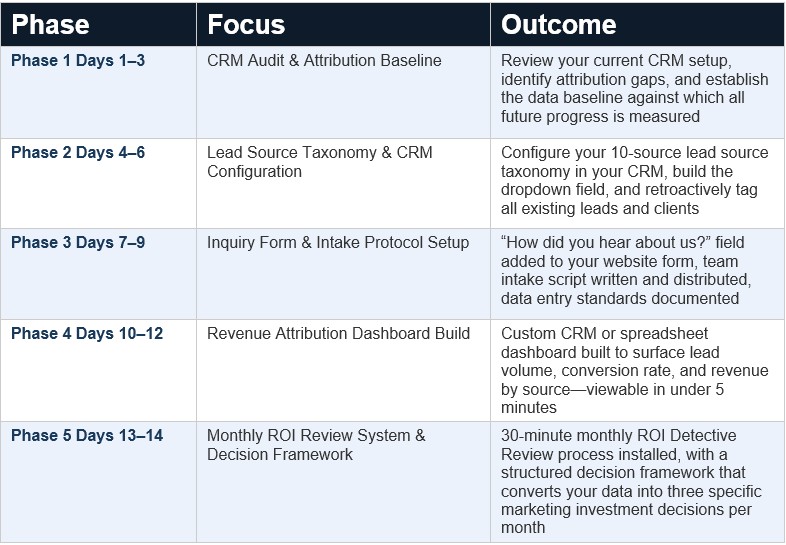
Revenue Attribution Intelligence System™
Transformations You Can Expect:
Complete visibility into which specific marketing channels are generating your revenue—with data, not guesses
A CRM configured with a clean, consistent Lead Source taxonomy across all active channels
A website form that automatically captures lead source data from every inquiry
A monthly 30-minute ROI review that replaces gut-decision marketing with evidence-based investment
A growing revenue attribution dataset that becomes more valuable every month you use it
The identity upgrade: from Gut-Decision Manager to ROI Detective—felt from the first monthly review
Ready to Follow the Money Trail and Finally Know What’s Working?
Partner with New Dawn Solutions and launch your Revenue Attribution Intelligence System™ in 14 days.
📅 Book My Free Strategy Consultation
“The ROI Detective follows the money back to where it came from. Every time. That habit—not talent, not budget—is what separates data-driven growth from perpetual guesswork.” — Jallah K. Bolay, New Dawn Solutions
P.S. This publication is brought to you by New Dawn Solutions Marketing and Consulting. Don’t let another marketing dollar disappear without attribution. Contact New Dawn Solutions now. newdawnsolution.com

